Showing posts with label cause. Show all posts

Saturday, August 23

Smoking? - Major diseases caused by smoking cigarettes

This blog has moved to a new website
Nutrition, Health & Wellness

Major diseases caused by smoking cigarettes
Quit smoking - major diseases are caused by smoking cigarettes.
Quit smoking. One of the causes of many life-threatening diseases is smoking. Cigarette smoking causes,initiates or promotes chronic obstructive pulmonary diseases (COPD), many types of cancers and cardiovascular Diseases. Even after quitting smoking, the risk of lung cancer may persist for more than 10 years. Cigarette smoke contains hundreds of toxic chemicals. It also contains nearly 70 carcinogens (cause cancer), including arsenic, vinyl chloride and 1,3–butadiene. People usually start smoking cigarettes in their teens just for the heck of it or under peer pressure.

How does smoking become an addiction?

Cigarette smoking becomes an addiction in a very short period of time. Nicotine is the known addictive chemical in cigarettes. Search is still going on for finding other possible addictive substances in the cigarette. Nicotine, a naturally occurring chemical found in tobacco is as addictive as heroin or cocaine.

Nicotine reaches the brain within seconds from the starting of smoking. Nicotine affects the chemistry of brain and the smoker develops physical and psychological dependence.
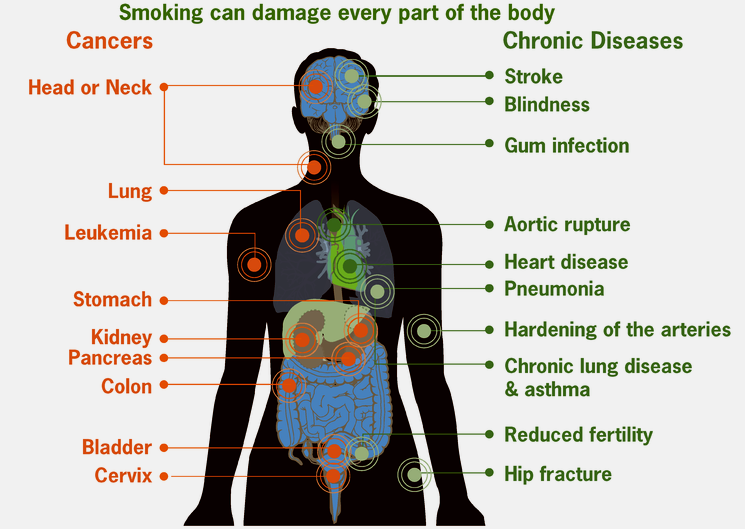
major diseases are caused by smoking cigarettes
1.diseases caused by smoking
However the effect wears off within a few minutes after putting out the cigarette. The withdrawal symptoms start and the craving for nicotine makes the person to light up again. Treating withdrawal symptoms is much easier than facing life-threatening diseases.

Smoking caused diseases

There is an awareness in the population that smoking can cause many health problems.
Many still continue to light up cigarettes because they do not know the severity of the health hazards. Smoking cigarette does not just end you up with sore throat and cough. Several fatal and devastating diseases will be the outcome of this harmful habit.

Smoking caused malignancy and cancers

Smoking significantly increases the lifetime risk of developing cancer. The direct contact with carcinogenic chemicals in the cigarette, their fumes and heat from cigarette cause mutations in the genes and growth of malignant cells in the oral cavity. The cancers of the oral cavity, including those affecting lips, tongue, floor of the oral cavity, insides of the cheeks and gum, are common among the smoking population.

The carcinogens in the cigarettes find their way into lungs while inhaling and can also cross the tissue barrier and get circulated to other parts of the body. This unfortunate habit can also induce other type of cancers such as:
  • Laryngeal carcinoma
  • Pharyngeal Cancer
  • Pulmonary carcinoma
  • Esophageal cancer
  • nasal cancer
  • Stomach cancer
  • Acute myeloid leukemia

Smoking caused cardiovascular diseases

These are diseases of the cardiovascular system which affect the heart and major and minor blood vessels.
Nicotine in the cigarette increases the level of LDL (bad cholesterol) leading to clogging, narrowing and hardening of the arteries. The narrowing of arteries is atherosclerosis. Cigarette smoking can cause accumulation of degenerative material in the inner layer of arterial walls, known an atheroma. The deposits in the blood vessels can narrow down and close the passage altogether and the disease is known as thrombosis. The clogged blood vessels can affect the individual's function depending upon the blood vessel involved and the degree of obstruction.

Arterial thrombosis, the formation of a thrombus in an artery, and atheroma can cause diseases like coronary thrombosis, cerebral thrombosis, myocardial infarction (heart attack), stroke, abdominal aortic aneurysm and pulmonary embolism. Thrombosis can affect the veins. Venous thrombosis affecting deep veins (femoral veins), portal veins, renal veins, jugular veins, hepatic vein, subclavian vein and dural venous sinuses may cause many vascular diseases.

Respiratory diseases

This harmful habit causes many non cancerous diseases of the respiratory system.
Oral cancer induced by smoking
2.smoking caused oral cancer

The fumes from the burning cigarette can irritate the lining of the lungs and can damage alveoli (air sacs). The fumes also kill the the cilia, hair-like structures present in the lining of the trachea which are involved in the cleaning of the air passage. The air passages may also narrow down due to thickening of the passages and accumulation of mucus. Lung function also gets regressed and hampered by smoking cigarettes. Chronic obstructive pulmonary disease (COPD), chronic cough, chronic bronchitis and emphysema (a degenerative disease) develop and progress into severity. About 50% of the people diagnosed with COPD die within ten years.

Prenatal and postnatal diseases caused by smoking

Nicotine, toxic fumes and other chemicals inhaled by the mother get passed on to the fetus through placenta and cause decreased fetal growth, premature births, abruptio placentae (placental abruption) and low birth weight.
Maternal cigarette smoking is found to have caused miscarriages, stillbirths and death of the baby during birth. Nursing mothers addicted to this habit can pass on harmful chemicals to the infants. It also found that maternal cigarette use can contribute to sudden infant death syndrome.

Impotence due to cigarette smoking

Smoking cigarettes causes erectile dysfunction (impotence) as the blood vessels get narrowed and sufficient blood supply is not maintained for erection.

Passive smoking

When one or both the parents are habituated to cigarette smoking, other nonsmoking members in the family undergo passive smoking. The family members, especially children are affected with respiratory diseases. They may also be affected by the fatal diseases, depending upon the amount and frequency of inhaled fumes.

This harmful habit also increases the risk factor for developing autoimmune diseases, type 2 diabetes, osteoporosis and loss of bone mass.


Related topics in health and fitness tips:
.
.
.
.
.
.
Bed wetting problems.
.
.
.
Image:1: Diseases caused by smoking cigarettes
License:Public domain.
Image 2: Oral cancer - a disease caused by smoking
Image source: http://en.wikipedia.org/wiki/File:Mouth_cancer_bionerd.jpg
Image author: Bionerd | License: CC BY 3.0.
Interesting topics in health and fitness tips:
.
.
.
.
.
How to stop chocolate cravings.
.
.
.
.

References:
1.Prabhat Jha, Richard Peto. Global Effects of Smoking, of Quitting, and of Taxing Tobacco. N Engl J Med 2014; 370:60-68 January, 2014.
2.Joshi V, Matthews C, Aspiras M, de Jager M, Ward M, Kumar P. Smoking decreases structural and functional resilience in the subgingival ecosystem. J Clin Periodontol. 2014 Aug 19. doi: 10.1111/jcpe.12300.
3.Kalucka S. Consequences of passive smoking in home environment. Przegl Lek. 2007;64(10):632-41.
Current topic in health and fitness tips: major diseases are caused by smoking cigarettes.

Thursday, November 29

Pneumonia in children and infants - Signs, symptoms & causes

This blog has moved to a new website
Nutrition, Health & Wellness

Pneumonia in children and infants
Home > Pneumonia - Signs and symptoms and causes of pneumonia in children and infants
Pneumonia in children and infants is a very debilitating medical condition and is sometimes fatal. The symptoms of pneumonia depend on the causes and the age of the affected child. The common origin of pneumonia in children are lung infections and inflammations caused by viruses, bacteria or fungi.

According to WHO, pneumonia kills an estimated 1.2 million infants and children under the age of five years, accounting for 18% deaths among this age group. It is estimated that one in three newborn infant die due to this disease. Of these deaths 85% occur in South Asia and sub-Saharan Africa. Simple interventions and timely treatment, care and preventive measures can stop loss of life.

Causes of pneumonia in infants and children

Pneumonia is inflammation of the lungs. Often, it begins as an upper respiratory tract infection affecting nose and throat which subsequently affects lower respiratory tract (lungs). The microscopic air sacs (alveoli) in the lungs bring about gas exchange, resulting in exhalation of CO2 and absorption of oxygen. In lung inflammation/infection primarily alveoli get affected. The inflammation causes alveoli to accumulate fluids and the surface area for gas exchange gets reduced. This results in respiratory distress and connected symptoms.

The lung inflammation and infection is usually caused by a variety of microorganisms, including bacteria, viruses, parasites or fungi. Bacterial lung infection in children and infants is usually caused by Streptococcus pneumoniae (or pneumococcus). Other common pneumonia causing bacteria are Haemophilus influenzae, Chlamydophila pneumoniae, and Mycoplasma pneumoniae, Staphylococcus aureus, Moraxella catarrhalis, Legionella pneumophila and Gram-negative bacilli. In infants and children affected by HIV, the incidence of this disease caused by Pneumocystis jiroveci is high and 25% of pneumonia deaths are due to P.jiroveci.

The viral lung infection in infants is commonly caused by Influenza virus A and B, Respiratory syncytial virus (RSV),Human parainfluenza viruses, rhinoviruses, human metapneumovirus and human bocavirus.

Fungal pneumonia in children is rarer and is mostly caused by Histoplasma capsulatum, blastomyces, Cryptococcus neoformans, Pneumocystis jiroveci, and Coccidioides immitis.
Parasites in human, which can affect the lungs, like Toxoplasma gondii, Strongyloides stercoralis, Ascaris lumbricoides, and Plasmodium malariae some times lead to fluid accumulation in lungs and pneumonia.

Pneumonia - Symptoms in infants and children

Viral and bacterial infections have similar symptoms and the viral infections are more numerous.
The common symptoms of pneumonia in infants and children include:
  • productive cough
  • nasal congestion
  • fever 
  • chills 
  • shortness of breath and difficult breathing
  • rapid breathing
  • increased respiratory rate
  • loss and lack of appetite
  • decreased activity and lethargy
  • wheezing
  • sharp or stabbing chest pain during deep breaths
  • abdominal pain
  • conjunctivitis due to chlamydia in infants

Symptoms of severity of pneumonia include:
  • lower chest wall in-drawing during inhalation in children
  • skin and nails becoming bluish,
  • inability to feed or drink in infants
  • decreased thirst
  • convulsions
  • nausea or persistent vomiting
  • Extremes of body temperature (fever or hypothermia)
  • decreased level of consciousness.
In children and infants with bacterial infections set in fairly quickly whereas the viral infections set in gradually.
Malnutrition or undernourishment, compromised immune systems and pre-existing illnesses increase susceptibility of infants and children and can cause pneumonia. Environmental factors like air pollution, crowded homes and parental smoking also increase the risks.

Treatment of bacterial lung infection involves administration of antibiotics and patient care. Viral infection may resolve after some time as the patient develops immunity. For severe cases and young infants hospitalization is necessary. According to WHO, vaccinations against Haemophilus Influenzae Type b (Hib), pneumococcus, measles and whooping cough (pertussis) is the most effective way to prevent pneumonia in infants and children.

Related topics in Daily Health News & Tips:
Pneumonia in elderly - causes, symptoms, prognosis and treatment.

References:
1.http://www.who.int/mediacentre/factsheets/fs331/en/index.html

Images:
1.Image source:
http://en.wikipedia.org/wiki/File:PneumonisWedge09.JPG
Image author: James Heilman, MD
License: CC BY-SA 3.0
2.Image source:
http://en.wikipedia.org/wiki/File:Symptoms_of_pneumonia.svg
Image author: Mikael Häggström
License: Public domain

Current topic: Symptoms and causes of pneumonia in children and infants

Tuesday, March 20

How to prevent muscle cramps? - How to avoid muscle cramps?

This blog has moved to a new website
Nutrition, Health & Wellness

How to prevent muscle cramps? Yes, you can prevent muscle cramps if you know the possible causes of muscle cramps.
Everyone of us would have experienced sudden painful muscle cramps during our sleep and also during our activities. In our daily activities our voluntary muscles are in a state of contraction and relaxation to control movements and posture. When the contraction (shortening, tensing or tightening) is involuntary for a brief movement with immediate relaxation, it is called spasm. If this type of involuntary contraction is forceful, painful and sustained, it is called cramps.

The duration is variable with cramps lasting anywhere from a few seconds to several minutes and may occur multiple times before restoration of normal function. In most cases, skeletal muscle of the lower extremities like calves, thighs, arches of the foot and toes is involved. Sometimes smooth muscle cramps may be experienced  in menstruation, endometriosis or gastroenteritis.

There are multitude of reasons for their occurrence and each individual incidence may have a different cause. The general cause is overworked or strained muscle and to prevent getting cramps we should not strain them. Causes of cramps include excessive flexing, oxygen depletion in body, sudden large changes of temperature, loss of body salts and electrolytes and dehydration.

Certain medications used for high cholesterol, hypertension, Alzheimer's disease, Parkinson's disease and diuretics can also cause cramps. Considering the causes and also the body parts involved, skeletal muscle shortening can be categorized into true cramps, dystonic cramps, tetany and contractures.

Hyper-excitability of nerves

  • Hyper-excitability of nerves stimulates muscle groups and causes true cramps.
  • Persistent contractions may be experienced after an injury as a protective response of the body.
  • To some extent pain relief medication and rest can prevent these contractions.
  • Straining and vigorous activity may induce contractions. It may happen during the activity itself or up to six hours after the cessation of the activity.
  • Proper warming up and cooling down exercises must be done before and after strenuous activity, workup and games to prevent these involuntary actions.
  • Similarly sitting or lying in the same position for extended period of time can cause fatigue and cramps.
  • Frequent change in position and stretching of the muscle involved can prevent tensing.

Prevent dehydration and electrolyte imbalance

Lots of body fluids may be lost due to hot conditions, strenuous exercises, excessive vomiting and chronic diarrhea. Use of diuretic medicine also removes body fluids and electrolytes. These situations lead to dehydration and low sodium, calcium and magnesium levels in the body fluids. This causes electrolyte imbalances in body fluids and results in muscle cramps.

To prevent such involuntary contractions sufficient water and fluids must be consumed in a regular basis. After considerable sweating,  replacement of electrolytes should be considered by taking electrolyte formulations.

Prevent nutritional deficiencies

Nutritional deficiencies of sodium, magnesium, calcium, vitamin D and vitamin B complex can cause cramps. To totally remove sodium from diet during treatment of hypertension can lead to cramps. In such cases moderate intake of sodium salts and fruit juices can prevent cramps.

Vitamin D is vital for the absorption of calcium in the body and any deficiency can lead to calcium imbalance. To prevent vitamin D deficiency sufficient exposure to sunlight and intake of vitamin D supplements is necessary.

Most of the vitamins in the B complex group have the function of toning up nerves and muscles and any deficiency can cause cramps. Intake of balanced diet and if necessary supplements can prevent deficiency of vitamins.

How to prevent acute cramps in sleep

Acute cramps during resting and sleeping is a most common occurrence especially in elderly.
  • To prevent such woes, attention must be given to their diet. Though the diet may appear balanced, deficiencies may arise as with old age the digestion and absorption capacity of GI tract declines.
  • The help of geriatric dietitian may be sought to balance their diet and supplements.
  • Apart from balanced diet, sufficient fluids must be consumed to prevent these acute cramps.
  • Moderate exercise to tone up the leg muscle and stretching legs a few times before going to bed can prevent this misery.
In tetany, spasms or cramps occur throughout the body due hyper-excitement of nerves. This conditions usually occurs due to imbalance of calcium and magnesium in body fluids; prevent tetany by consuming supplements.

Contractures are spasms wherein the affected muscle group is unable to recover from contraction. Usually muscle failure is due to depletion of glycogen and blood glucose leading to depletion of Adenosine Triphosphate (ATP) in cells.

Repetitive activities can produce dystonic cramps wherein the muscle not required for the intended movement and/or working in the opposite direction of the movement contracts; prevent repetitive activities for long duration. Regular moderate exercises, intake of balanced diet and consumption of sufficient fluids can prevent muscle cramps.